

by Julia Bruce
Photos by Badge and Bark Photography
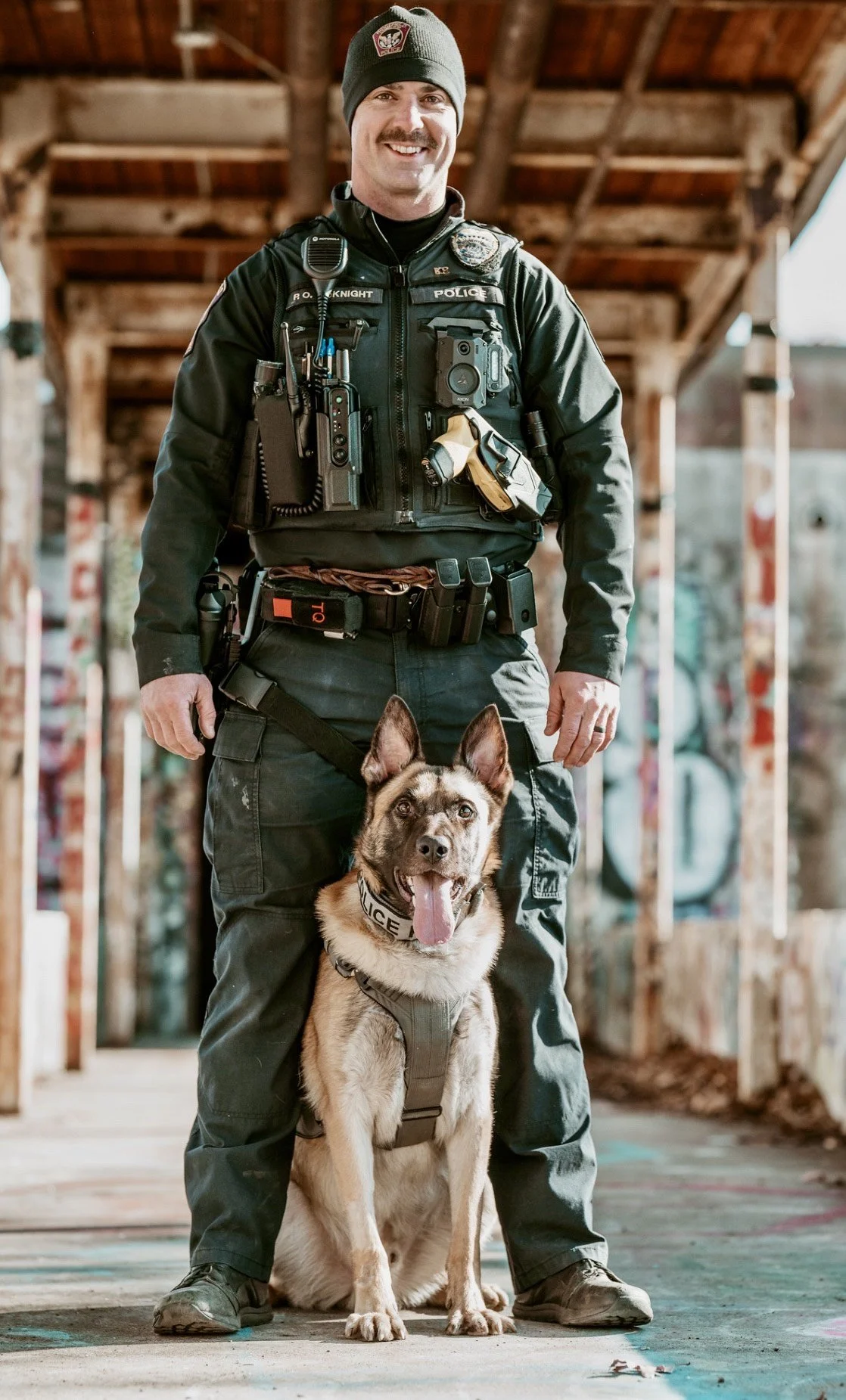
Police officers notoriously have a special bond with their patrol partners and rightfully so, because sometimes their very lives depend on those relationships. That connection is a strong one, whether your partner has two legs, or, when it comes to K-9 units, four.
K-9 police units first were used in Belgium in the late 1800’s. Since then, canine officers have become an integral component of many police forces – working alongside their human partners to keep communities safe.
Ridgefield Police Officer Michael McKnight, who grew up in town, always knew he wanted to be a part of the K-9 Unit. McKnight’s high school football coach was Shawn Murray, who was responsible for reviving Ridgefield’s K-9 unit in the early 2000’s and served with his dogs Zeus and Loci. Lt. Murray worked alongside Officer McKnight, offering advice and support with this training.
Officer McKnight had seven years on the job before joining the K-9 Unit.
He was matched with Odin, a German Shepherd Belgian Malinois mix, who came from a Slovakian breeder that specializes in police and military dogs. “He has both the herding trait as well as a little of the crazy energy,” says McKnight.
Danbury Police Sergeant Alex Relyea’s dog Gunner is a black German Shepherd that originally was trained in the Czeck Republic. “We’ve been together eight years now. His performance has been extraordinary,” says Relyea.
ON THE JOB
Dogs and their handlers attend months-long training academies to build their relationship and to work on obedience, skills (such tracking, detection, and apprehension), and commands. Training is constantly being reinforced in order to stay sharp and ready for work.
“Mainly we use Odin for tracking missing persons, whether it’s either a mental health crisis, a dementia patient, or a lost child. We want to find that person as soon as possible,” says McKnight. The dogs follow what McKnight calls the ground disturbance. “They can follow the scent from grass to pavement back to grass,”
he says.Additionally, police dogs are skilled in suspect apprehension. “I continue to reinforce the bite command, so the dog will continue to hold, until we have the person in custody. I can then give him the out command,” says McKnight. While bite work training is important, Sergeant Relyea is proud of the fact that he has never had to utilize his dog in that mode. “Gunner’s presence has had a deescalating effect in many situations. It’s amazing how many fights haven’t occurred or chases haven’t happened because he’s with me,” says Relyea.
Building searches are another dangerous task for the dog – they literally are the first ones to enter a building to find an intruder. “Then we give a search and bite command,” says McKnight. While there isn’t a huge drug problem in the area, the dogs are trained to detect narcotics such as fentanyl and meth - it doesn’t take much for them to smell it.
The dogs wear custom-fitted bullet-and-knife-proof harnesses that offer protection. Should the police dog get injured, they are given the same honors and respect as their human counterpart. The harnesses are also used by their partners to give signals to the dog. “If I clip his leash on the rear hook, we’re in tracking mode. If we use the front hook, he’s more in aggression mode and he knows that it’s on,” says McKnight.
AT HOME
Being a K-9 officer is a 24-hour job – Odin and Gunner both live at home with their officers. Transitioning from work to home is important. “At the end of the day, I take off his e-collar and that is the signal that he’s off-duty,” says McKnight. “When we leave in the morning, I turn it on, and he perks up because he knows he’s back to work.”
While at home, the dogs can interact with the officer’s family but not often with other dogs. “You need to remember that they aren’t the same as regular pets,” says Relyea. Both officers use dog crates at home – it gives the dog a safe space to decompress.
Working dogs have a ton of energy. “I live on 12 acres that Gunner can run on. It’s almost impossible to tire him out,” says Relyea.
THANK YOU FOR YOUR SERVICE
Police dogs usually serve about ten years, but it really depends on the dog’s health – any sign of a decrease in performance or injury can signify that it’s time to retire. Once retired, the dogs live out the rest of their lives at home with the partners. “Gunner is ten years old and isn’t showing any signs of slowing down,” says Relyea. Neither officer likes to think about their dog’s retirement. “Our bond is indescribable. He hasn’t left my side for eight years.”•