

by Julia Bruce
Designed by
Alanny Perez, CT State
Flag Etiquette
Display the flag from sunrise to sunset. Flags flown at night need to be illuminated.
Do not display the flag in inclement weather.
Do not let the flag touch the ground.
When not on display, the flag should be respectfully folded in a triangle.
When flown at half-staff, the flagshould be first hoisted to the peak for an instant and then lowered to the half-staff position.
The flag should be again raised to the peak before it is lowered for the day.
haven’t always given much thought to my relationship with patriotism. Sure, when I was a child, I said the Pledge of Allegiance every morning in school. As a mom, I regularly dressed my children in red, white, and blue for the annual Fourth of July parade. And, as a grieving daughter, I accepted the folded flag handed to me by a soldier at my father’s military honors funeral. At each of these events, the American flag was prominently featured. Known under many names – Stars and Stripes, the Red, White, and Blue, Old Glory – the flag of the United States of America is more than just a national symbol; it is a historical and cultural icon. This year, as we celebrate our nation’s 250th anniversary, we have the opportunity to reflect on the symbolism of that flag and what it says about our feelings about our country.
THE EVOLUTION OF THE FLAG
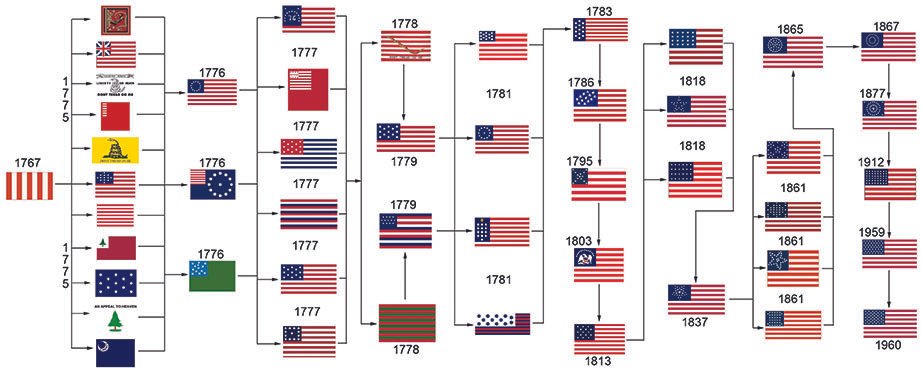
Historical lore claims the first flag was designed by New Jersey Congressman Francis Hopkinson and sewn by Philadelphia seamstress Betsy Ross – although in reality, there is no written documentation to support this beloved legend. The American flag’s story officially began on June 14, 1777, after the Continental Congress passed the Flag Resolution, defining the design of the American flag with the following declaration: “That the flag of the thirteen United States be thirteen stripes, alternate red and white; that the union be thirteen stars, white in a field of blue, representing a new constellation.” The colors of the flag are symbolic as well: red for hardiness and valor; white for purity and innocence; and blue for vigilance, perseverance, and justice. On August 3, 1949, President Harry S. Truman officially declared June 14th as Flag Day. The flag has since been updated 27 times to include new states. The current 50-star version was designed by a high school student for a history project and was adopted on July 4, 1960, after Alaska and Hawaii achieved statehood.
CONTINUED PRESENCE
Throughout American history, in times of celebration as well as crisis, our flag has been a steadfast symbol representing our country’s resilience and unity. As a nation, we have witnessed our flag displayed at Olympic medal ceremonies and draped over returning soldiers’ coffins. It has been a constant presence in significant and also everyday events – from inaugurations of presidents to high school football games. The flag rose from the rubble of 9/11 and was planted on the surface of the moon. And while our country may sometimes seem divided, the American flag can stand as a reminder of the nation’s shared ideals and evoke a sense of national pride and collective responsibility. The values that the flag stands for – freedom, democracy, and justice for all – should be viewed as goals that we as a country must continually strive to achieve.
ARTISTIC IMPRESSIONS
Since the birth of our country, the American flag has been featured in paintings, photographs, and sculptures – artistic statements that either celebrate or oppose current political situations. Notable pieces of artwork include Childe Hassam’s “The Avenue in the Rain” (1917), which currently hangs in the White House. Painted months before America entered World War II, this painting depicts a large flag and several smaller flags reflected on the wet street and sidewalk. Another famous piece of artwork is Jasper John’s “Flag,” which was made on a cut bedsheet using oil paint and then encaustic, a method involving pigmented melted wax. John’s work is celebrated for its textured, painterly surface and its ambiguous, neutral stance between patriotism and critique. The flag has also been featured in defining moments in American history, from Joe Rosenthal’s photo of the American flag being raised atop Mount Suribachi at Iwo Jima to Neil Armstrong’s photograph of his colleague, Buzz Aldrin, standing next to the American flag on the Moon. More recently, Keith Haring’s “American Music Festival - New York City Ballet” (1988) is a contemporary piece that features his signature bold, energetic figures interacting playfully with an American flag, with characters leaping, tumbling, and nudging the stars and stripes.
In honor of America’s 250th, the National Gallery of Art is hosting an exhibition entitled “American Icon – The US Flag in Art” from June 6th through December 6th. The installation will feature artworks from the late 1800s to the present day, exploring what the flag represents and how people connect with it. •